

- Telescopes
- Overview:
Telescopes - Achromatic Refractor
- Apochromatic Refractor
- Overview:
Apochromatic Refractor - ED Refractor - less color aberration than an achromatic
- SD APO - color free 2-element APO objective
- EDT APO - 3 element ED objective
- High End APO with 3-element APO objective - no color aberation
- Flatfield APO with flat field for Astrophotography
- All Apos and EDs from all manufacturers - large overview
- TS APO and ED from Japan with high quality optics
- Overview:
- Newtonian Telescopes
- Dobsonian Telescopes
- RC Ritchey Chretien Telescopes
- Casssegrain Telescopes
- Reflektor Telescopce with Lens Correcture
- Maksutov Cassegrain Telescopes
- GoTo Telescopes
- Smart Telescopes
- Solar Telescopes H-Alpha
- Overview:
- Mounts Tripods Rings Rails Power Supply ...
- Overview:
Mounts Tripods Rings Rails Power Supply ... - Mounts Equatorial with GoTo
- Mounts Equatorial without GoTo
- Mounts Azimutal with GoTo
- Mounts Azimutal without GoTo
- Mounts GoTo - Harmonic Drive
- Travel mounts for astro imaging
- Tripods Piers Polar Wedges
- Mount Control & Electronics
- Dovetail Clamps, Plates and Mount Adapters
- Tube Rings
- Power Supply
- Counterweights Balance Weights
- Mount Accessories - Other
- Overview:
- Telescope Accessories
- Overview:
Telescope Accessories - Eyepieces
- Barlows & Reducer Lenses
- Diagonal Mirrors and Prisms
- Binocular Viewers
- Finder Scopes
- Telescope Collimation and Test
- Cleaning Tools
- Transport and Storage
- Dust protection for Telescopes & Accessories
- Stray Light Protection
- Dewcaps and Heater
- Focusers, Adapters, Motorfocus
- Telescope DIY & Improvement
- Other telescope accessories
- Replacement Parts
- Overview:
- Filters
- Overview:
Filters - Color Filters and Color Filtersets
- Nebular Filters for Visual Observing
- Neutral-Density and Polfilter
- Photo Narrowband Nebular Filters
- Photo Broadband Filters
- Photo Planetary Filters
- Photo R-G-B and IR Cut Filters
- Photo - Filtersets
- Photometric Filters
- Clip Filter for DSLR Cameras
- Filter Wheels and Filterslider
- Solar Filters for white light
- Solarfilter for H-Alpha and Calcium
- Overview:
- Adaptors
- Overview:
Adaptors - Adapter 1,25" and 24,5mm
- Adapter 2"
- Adapter T2 - M42x0.75
- Adapter M48x0,75
- Adapter M54
- Adapter SC
- Adapter M63
- Adapter M68
- Adapter to other Threads
- Adapter Extensions
- Adapter camera bayonet
- Adapter Objective Filterthread
- Adapter Quick Changing , Rotation
- Adapter Eyepiece Projection
- Adapters Tilting
- Overview:
- Astrophotography and Photography
- Overview:
Astrophotography and Photography - Cooled Cameras
- Cameras without Cooling
- Deep-Sky Cameras uncooled
- Set-Offers Camera, Filter, Wheels
- Acessories for Cameras
- Travel mounts for astro imaging
- Imaging Correctors for Telescopes
- Autoguiding Cameras & Sets
- Everything for Guiding
- Focusing aids - Bahtinov mascs
- Flat Field foils and boxes
- Lenses for Cameras
- Piggyback Camera Holder
- Camera Bags, Photocases & more
- Digital Camera and Smartphone Adapter
- Other photo accessories
- Overview:
- Binoculars, Spotting Scopes, Microscopes, Range Finders
- Overview:
Binoculars, Spotting Scopes, Microscopes, Range Finders - Spotting Scopes and Acessories
- Roof Prism Binoculars
- Binoculars with Porro prisms
- Binoculars from 100mm Aperture
- Binoculars with 1,25 inch eyepieces
- TSMX APO Binoculars
- Binoculars for Astronomy
- Binoculars Hiking Bird watching
- Monoculars - Opera Binoculars
- Accessories for Binoculars
- Range Finders
- Microscopy
- Bags for Phototripods & Binoculars
- Overview:
- Phototripods and Binomounts
- Books, Software
- Overview:
Books, Software - Books for Astronomy Beginners
- Star Charts and Planispheres
- Books about our Solar System
- Observing Tips for Amateurs
- Popular Astronomy Literature
- Teaching material
- Astrophotography books
- Telescopes, Observatories, Construction
- Calendars Yearbooks
- Software, Star Charts
- Books for Microscopers
- Books Nature and Animals
- Nature Photography TimeLapse
- Overview:
- Night Vision, Magnifiers, Weather, Domes & more
- Beginner Astronomy and Gift Ideas
- Second Hand & Special Offers
- New products

manufacturers


Manufacturer: Baader
Product number: Sofi50v
EUR79.00new
EUR 79,00
incl. 19 % VAT (DE)
The VAT indicated refers to that applicable in Germany. After logging in, the VAT amount is adjusted to the applicable VAT of the stored delivery country. Therefore, the final price may vary accordingly.
excl. 7.95 € shipping costs (DE)
more details to the shipping costs ...Please log in to calculate shipping costs to your country.

rating: 5.0 of 5Baader AstroSolar® ClearWhite Safety Filter Film OD 5.1, 50 cm x 50 cm5


- Details..
- Technical data..
- In the box..
- Reviews..
- Download..
- Manufacturer infos..
- Safety informations..
Baader AstroSolar® ClearWhite Safety Filter Film OD 5.1
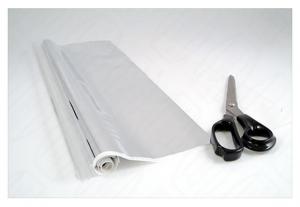
The Baader AstroSolar® ClearWhite Safety Film OD 5.1 is a high-quality, double-sided metallized solar filter film designed for direct solar observation as well as for constructing front-mounted objective filters for telescopes, binoculars, spotting scopes, and camera lenses.The film has an optical density of OD 5.1 and reduces the intensity of sunlight by approximately 99.9992%, corresponding to a reduction factor of about 125000. It complies with the applicable transmittance requirements of EN ISO 12312-2:2015 for filters intended for direct observation of the sun.
Compared to the previous AstroSolar® Safety Film OD 5.0, the new ClearWhite version provides an even clearer, whiter solar image along with a slightly higher optical density. Sunspots, granulation, and fine structures of the photosphere can be seen sharply and richly contrasted when used with suitable optical equipment.
Clear white solar image with high optical quality
AstroSolar® ClearWhite Safety Film OD 5.1 was developed to provide a particularly neutral, clear white solar image. Undesirable bluish or orange color casts, which may occur with simpler solar filters, are largely avoided.
The film is manufactured from a special streak-free and bubble-free substrate and achieves an optical quality comparable to high-quality plane-parallel glass filters despite a thickness of only 0.012 mm. The material is not ordinary "Mylar" and was developed for exceptionally high uniformity and optical purity.
The double-sided coating ensures especially uniform filter performance and reduces the effect of isolated microscopic irregularities in the metallization. A single layer of AstroSolar® ClearWhite Safety Film OD 5.1 is sufficient to produce a safe solar filter with excellent image sharpness.
For direct solar observation and front-mounted objective filters
AstroSolar® ClearWhite Safety Film OD 5.1 can be used for direct solar observation with the naked eye when handled correctly. This requires that the film is undamaged and used in a suitable, light-tight, and securely mounted holder.
For telescopes, binoculars, spotting scopes, and camera lenses, the film must only be used as a front-mounted objective filter. The filter must be positioned in front of the optical entrance aperture, securely cover the entire opening, and be protected against slipping, loosening, or being lifted by wind.
Visual and photographic use
The AstroSolar® ClearWhite Safety Film OD 5.1 is equally suitable for photography and visual observation. With the focal ratios of typical telescopes and camera lenses, exposure times are short enough to capture sharp images of the sun in single exposures or to perform lucky imaging. This is perfect for observing and photographing the sun under normal conditions as well as during the partial phases of solar eclipses.
You also do not need to worry when looking through a camera viewfinder, as this can be done safely when the filter is correctly installed in front of the optical system.
Construction of custom solar filters
High-quality solar filters for telescopes, binoculars, spotting scopes, and camera lenses can be made from AstroSolar® ClearWhite Safety Film OD 5.1 in just a few simple steps.
Detailed assembly instructions and safety information are included with every sheet of film. They are also available for download on this website. Stress-free mounting is essential: the film must not be stretched tight or pulled under tension. It should be mounted wrinkle-free, but without mechanical stress, in order to preserve its high optical quality. The film may sit slightly wavy or somewhat loose in the holder without negatively affecting optical performance.
Inspect both the film and the holder before each use. Do not use the film if it shows tears, holes, creases, major scratches, delamination, loose areas, or extensive wipe or abrasion marks. Damaged film must not be repaired and must be replaced immediately.
Safety instructions for solar observation
Never look directly at the sun without a suitable and undamaged solar filter. Ordinary sunglasses, emergency blankets, CDs, photographic neutral density filters, or other untested materials are not suitable for visual solar observation, as they may transmit dangerous portions of invisible radiation (UV and IR) that are not directly visible but can still cause permanent eye damage.
A safe solar filter is also required during a partial or annular solar eclipse. Only during the brief phase of complete totality in a total solar eclipse - when the sun´s photosphere is entirely covered by the moon - may the solar corona be observed without a filter. As soon as any part of the solar disk becomes visible again, an appropriate solar filter must be used at all times.
Children may only use solar filters under adult supervision. Never leave solar filters, eclipse glasses, handheld viewers, solar telescopes, binoculars, or cameras unattended.
| Optical density: | OD 5.1 |
| Transmission: | approx. 1/125000 |
| Solar Wavelength: | White light (integral light) |
| Substrate: | special film, developed for scientific use |
| Coating: | aluminium |
| Optical quality: | diffraction limited |
| Safety: | certified |
| Size: | 50 cm x 50 cm sheet |
| Net weight: | 0.007 kg |
Images from a comparative test
Interferometrical Test

Reference
Ideal picture - Strehl 1.01
(only theoretical)

Baader AstroSolar
close to the optimum -
like a good objective

Mylar Solar foil
irregularities are obvious. This would be
neither a good filter nor a good objective
Star test

Reference
Airy disc - 99.9% Strehl
(only theoretical)

Baader AstroSolar
94,1% inside the Airy disc
Comparable with a very good objective

simple mylar solar filter
57,2% inside the Airy disc
not diffraction limited any more
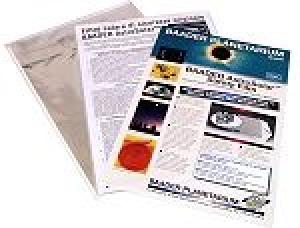
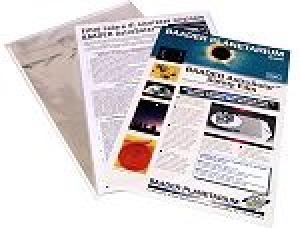
Safety and Application Instructions on AstroSolar ClearWhite Safety Film OD 5.1
How to build your own AstroSolar filter
How to build your own AstroSolar filter
| Manufacturer / Importeur: | Baader Planetarium GmbH |
| Street: | Zur Sternwarte |
| ZIP / City: | 82291 Mammendorf |
| Country: | Germany |
| Telefon number: | +49 8145 80890 |
| Email: | kontakt@baader-planetarium.de |
| Website: | www.baader-planetarium.com |
Safety informations: PDF Download
Recommended accessories
Cleaning & Collimating
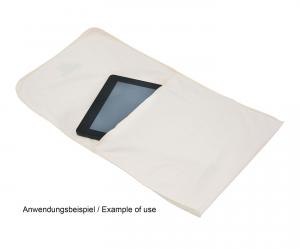
TS-Optics Optical Soft Microfibre Cleaning Cloth and Bag, 26x24 cm
EUR 7,50RRP EUR 11,95you save 37.2% (EUR 4,45)
Eyepiece-side accessories like Filters

Finder & Accessories
Similar Products
Baader AstroSolar® ClearWhite Safety Filter Film OD 5.1, 100 cm x 50 cm

- Only 3 pcs left in stock
EUR 115,00
Baader AstroSolar® ClearWhite Safety Filter Film OD 5.1, Giant-size 117 cm x 117 cm
- Only 1 pcs left in stock
EUR 395,00
Baader AstroSolar® ClearWhite Safety Filter Film OD 5.1, 58 cm x 58 cm
- Only 3 pcs left in stock
EUR 99,00
Reviews
Written by Winfried Bortscheller
on 2026-08-27
"Hab die Folie bei der Sonnenfinsternis fotografisch verwendet, hat gute Bilder geliefert."
Written by Jürgen Zeiher
on 2026-08-20
"Wurde wie auch bei früheren Basteleien erfolgreich bei der partiellen SoFi. eingesetzt."
Written by Wilfried Brokmeier
on 2022-09-09
"Wechsel die alte Baaderfolie in den vorhandenen Rahmen aus!"
Written by Eva brobst
on 2022-06-09
"Alles super, top Ware, schnelle Lieferung, sehr gut verpackt - bestellen gern wieder!"
Written by Evgeniy Bogatyrev
on 2021-03-25
*****
Written by Michael Kampmann
on 2020-11-29
"sehr gute Verarbeitung. Angenehmes Bild bei visueller Beobachtung"
Written by Klaus-Peter Janovics
on 2020-06-24
"Wird von mir visuell und fotografisch verwendet an einem 6-zölligen Achromaten. Die Folie erscheint mir beugungsbegrenzt und ist von der Mindest- bis hin zur förderlichen Vergrößerung in angenehmer Helligkeit verwendbar. Sie ist für Anfänger und fortgeschrittene Beobachter gleichermaßen bestens geeignet! Von mir eine klare Empfehlung!"
Written by Theis Thomas
on 2020-06-21
"Die Lampe ist genau so wie in der Artikelbeschreibung. ich bin zufrieden. Schnelle und sichere Lieferung."
Written by Sebastian Georgi
on 2020-04-19
Einwandfrei
Written by Christian Priller
on 2019-12-17
"Die Größe der Folie ist super. Man kann die Folie individuell anwenden (bei mir Teleskop, Sucher und DSLM Kamera) und je nach verwendung hat man dann immer noch einen Rest übrig. Zur Folie: wurde bereits getestet und sie ist sehr angenehm. Die Sonne leuchtet in einem schönen hellen weiß. Sonnenflecken waren seither leider noch nicht vorhanden, deshalb kann ich nichts zum Kontrast und zu deren Abbildung sagen. Da aber auch so der Kontrast sehr gut ist, denke ich dass die Flecken gut abbgebildet werden. Ich kann dieses Produkt jedem empfehlen, der sich auch unseren Heimatstern genauer ansehen möchte. "
Written by Gordon Kleyer
on 2017-08-01
"Die Folie macht was sie soll, macht einen stabilen Eindruck. Die Anfertigung eines Filters war problemlos."
Written by Philip Ransley
on 2017-05-30
"Well packaged"
Written by Ton Sijm
on 2016-07-31
"I´ve mae 2 solarfilters out of it, they look and work as expected."
Written by Jean-Pierre Faugeron
on 2016-07-30
"trés bien"
Written by Nikolaus Hanjohr-Popa
on 2016-05-23
Spitze
Written by Martin Müller
on 2016-05-23
"Macht was sie soll."
Written by Edmund Serpell
on 2016-05-04
"as expected"
Written by Yuriy Didenko
on 2016-04-02
"Yet I am looking at the sun, but I think the quality of the film on top."
Written by Franz Hoja
on 2016-03-15
"Alles sehr gut"
